
From Camera Feeds to Flow Decisions: How AS-TECH’s Person Flow Management System Solves Congestion
AS-TECH’s iPFM leverages NVIDIA Metropolis technologies for real-time agentic vision AI applications with an AS-TECH-developed operational digital twin and what-if simulation, helping venue teams move from watching crowds to making evidence-backed decisions.
By AS-TECH
During an evening departure peak, a queue begins to grow near an airport immigration zone. The cameras are working. Flight schedules and counter status are available. Operations teams can see the crowd forming across several screens.
But the questions that matter are harder to answer: Which passenger flows are affected? Why is the queue expanding even though some processing capacity remains available? Would opening another counter solve the problem, or simply move the bottleneck somewhere else?
This visibility gap appears anywhere large numbers of people move through shared spaces. Airports, shopping centers, transit hubs, stadiums, campuses, and public venues may have extensive camera coverage and multiple operational systems. Yet video, queue measurements, facility data, schedules, alarms, and service information often remain separated. Teams can see individual conditions but still have to assemble the broader story manually.
AS-TECH developed Intelligent Person Flow Management, or iPFM, to close that gap. iPFM turns existing camera networks and authorized venue data into a unified people-flow intelligence platform. It connects measured movement, live and recorded video data, spatial context, operational data, and scenario simulation in one decision workflow. Teams can use it to identify emerging congestion, search likely contributing factors, understand the areas and journeys affected, and compare possible interventions before taking action.
Moving Beyond People Counting
Traditional people-counting systems answer an important but limited question: How many people crossed a line or entered a zone?
Managing a complex venue requires a more connected view. Teams need to know how quickly people are arriving, where they dwell, how queues are changing, which routes they take, how long journeys take, and whether congestion in one area could propagate into another.
iPFM converts video into pseudonymous spatial events such as zone entry and exit, occupancy, density, direction, dwell, queue formation, and cross-camera transitions. Temporary identifiers support journey and flow analysis without requiring PII enrollment for the platform’s core people-flow functions.
These observations can be combined with authorized venue context. In an airport, that can include flight schedules, gate assignments, counter availability, service capacity, boarding milestones, facility status, and service-level targets. In a shopping center, the same foundation can incorporate store zones, events, operating hours, tenant operations, and authorized point-of-sale information.
iPFM supports configurable retention periods, role-based access controls, and data-governance policies aligned with venue requirements and applicable regulations. The result is not another camera wall, but a governed model of how demand, capacity, and physical space interact.
Turning Video into Searchable Operational Memory
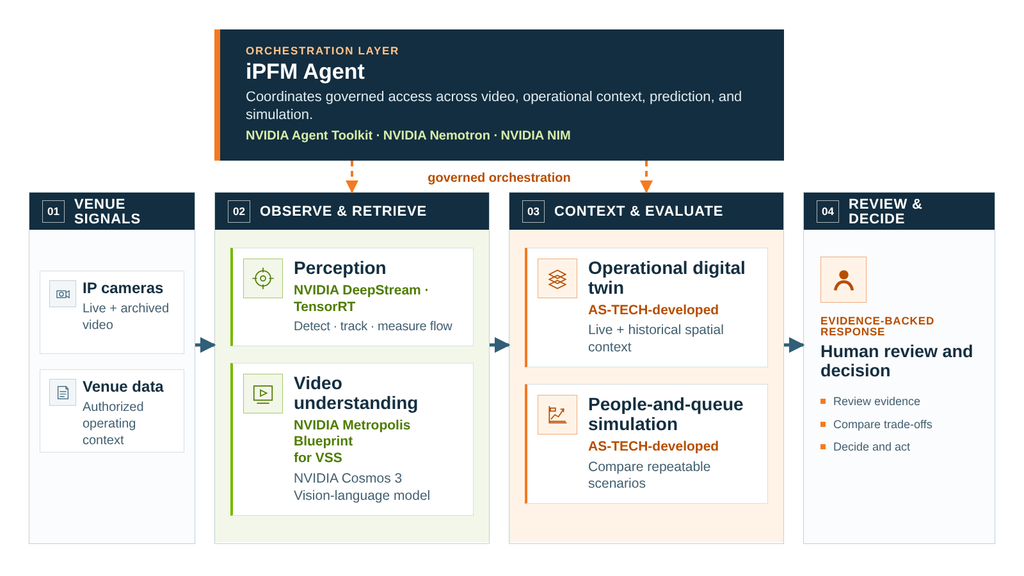
iPFM’s perception layer uses the NVIDIA DeepStream SDK for multi-stream ingestion, hardware-accelerated decoding, batching, inference orchestration, and tracking. NVIDIA TensorRT accelerates neural-network inference, while the pipeline generates structured measurements for occupancy, flow, queues, and events.
Structured analytics remain essential because teams need repeatable measurements, not estimates generated by a language model. But measurements alone cannot always explain the physical context of an event. A detector may report that a queue crossed a configured boundary; it may not explain that the queue is spilling into a circulation corridor while passengers hesitate at an unclear entry point.
Part of the agentic layer, iPFM leverages the NVIDIA Metropolis Blueprint for video search and summarization (VSS). Within the VSS pipeline, NVIDIA Cosmos 3 serves as the vision-language model (VLM), adding physical-world-aware understanding to relevant video. Video search, retrieval, and summarization services turn live and archived video into searchable operational memory for natural-language search, alert review, interactive questions, and report generation.
An airport team can ask:
- “Show where queues expanded into circulation paths during the last departure peak.”
- “Summarize the events that preceded congestion at Immigration Zone 2.”
- “Which camera views show passengers changing lanes before the waiting time increased?”
- “Find periods when a service point was available but the adjacent queue continued to grow.”
Instead of searching camera by camera and scrubbing through hours of footage, the team can move from a question to the relevant clips, measurements, locations, and timeline.
Connecting Events to Place with an Operational Digital Twin
Understanding what happened in a video is only part of the problem. Teams also need to know where the event occurred and how it relates to the wider venue.
iPFM grounds camera observations in an AS-TECH-developed operational digital twin—a calibrated spatial representation of the venue connected to live and historical flow data. Calibrated camera views and multi-camera tracking place pseudonymous observations into a shared coordinate system. The twin connects these observations with floors, zones, walkable paths, service points, queues, facilities, and transitions such as stairs, escalators, and elevators.
The shared spatial context turns separate camera detections into connected journeys. Teams can inspect density and flow overlays, review representative paths and cross-camera transitions, and see how congestion may affect nearby routes and facilities. Historical evidence can be replayed against the same map, allowing a team to move from an aggregate pattern to a pseudonymous journey or event timeline.
Asking Why, Not Just What
The iPFM Agent serves as the top-level orchestration layer across VSS and the platform’s operational services. Built with NVIDIA Agent Toolkit, it uses an NVIDIA Nemotron reasoning model served through NVIDIA NIM. Native function calling connects the agent to governed tools for video search, measured flow, digital-twin context, enterprise data, predictive services, simulation, and venue procedures.
The agent keeps measured values, contextual interpretations, predictions, and simulated outcomes distinct, while presenting them together with supporting evidence.
Consider the question:
Why is Immigration Zone 2 becoming congested, which passenger flows are affected, and what action could reduce waiting time with the least operational impact?
To respond, the iPFM Agent retrieves queue and flow measurements, asks VSS to locate and summarize the relevant video, uses digital-twin context to identify affected routes, and correlates the condition with authorized flight and service-capacity data. iPFM identifies likely contributing factors and presents the evidence supporting each one. The evidence may show, for example, that passengers are converging on a subset of lanes while another lane remains underused, consistent with the current barrier arrangement influencing route choice. When a question requires a forecast or intervention comparison, the agent can also call predictive services and the iPFM simulation engine, retaining the relevant inputs, assumptions, and results.
Each answer links to supporting metrics, clips, locations, and time windows, giving the team a clear basis for evaluating each conclusion.
Comparing Interventions Before Acting
Once likely contributing factors are identified, the next question is practical: What should the team change?
iPFM includes AS-TECH’s deterministic, event-driven people-and-queue simulation for evaluating projected trade-offs under stated assumptions. Its hybrid model combines agent-level movement and routing behavior with discrete service and queue events. Teams can define service stations, modeled passenger types, arrival patterns, routes, destinations, lane configurations, and processing capacity, then compare queue length, waiting time, throughput, utilization, journey time, and congestion propagation.
For the immigration example, iPFM can evaluate alternatives such as:
- Opening one additional counter.
- Opening two counters for a shorter period.
- Changing the barrier configuration to distribute passengers more evenly.
- Redirecting selected passenger flows to another service area.
- Combining an additional counter with a revised route.
The simulation replays each scenario on the operational digital twin and preserves its assumptions and results for comparison. The agent can summarize the trade-offs, such as an option projected to reduce waiting time while requiring less additional staffing than a larger intervention. These modeled outcomes give operators a consistent basis for comparing options; authorized personnel review the evidence and make the final decision.
This closes the decision loop that began with a growing immigration queue. iPFM detects the developing condition, retrieves the relevant video, surfaces likely contributing factors, compares counter and barrier scenarios, and presents the projected trade-offs for operator review. After an intervention, the platform can compare the observed result with the simulation, helping the team assess policies and improve future decisions.
AS-TECH Evaluation Powered by NVIDIA Accelerated Computing
AS-TECH measured the performance of iPFM’s perception and spatial capabilities on NVIDIA accelerated computing platforms:
- In an AS-TECH test, a single NVIDIA RTX PRO 6000 Blackwell Server Edition GPU processed 100 concurrent mixed-resolution RTSP streams with detection and tracking enabled, sustaining 449 aggregate analytics frames per second, or 4.49 frames per second per stream on average. iPFM’s movement-aware processing reduces unnecessary inference during inactive periods, while deployment capacity is sized to scene activity, video configuration, model complexity, and enabled analytics.
- In an 18-camera AI City MTMC 2024 evaluation with 3,000 annotated frames per camera, ground-plane matching of predicted and ground-truth positions within one meter yielded an F1 score of 0.9010, with 93.07% precision and 87.62% recall.
- In a separate six-scene AI City MTMC 2024 multi-camera 3D tracking evaluation, median ground-position error was 0.244 meters, and 98.6% of evaluated positions were within one meter of ground truth.
Results were measured by AS-TECH under defined test configurations and may vary by workload and deployment conditions.
From Airports to Other High-Flow Venues
Airports provide a demanding proving ground for iPFM because they combine large crowds, time-sensitive services, complex journeys, commercial areas, security processes, and interconnected facilities. The same foundation can be configured for other places where demand, capacity, and movement must be managed together.
Shopping centers can analyze traffic, dwell, route share, space utilization, and queue conditions. Transit hubs can study transfers, platform access, and crowding, while stadiums and event venues can examine ingress, concessions, and egress. iPFM can be configured around each environment’s integrations, governance rules, and success measures while addressing the same decision need: turning cameras and venue systems into a clearer understanding of people, space, and service performance.
iPFM brings real-time perception, searchable video understanding, spatial intelligence, agentic AI, and what-if simulation into one platform. It helps teams move beyond watching conditions as they unfold to investigating why they may be changing, evaluating possible responses, and acting with stronger evidence.
Get Started
To discuss an iPFM assessment or deployment for an airport or another high-flow venue, visit AS-TECH or iBOC. Developers can explore the NVIDIA technologies implemented by iPFM with the NVIDIA DeepStream SDK and the NVIDIA AI Blueprint for video search and summarization.
About AS-TECH
As a Service Technology Co., Ltd. (AS-TECH) is a Thailand-based AI and IoT company delivering operational intelligence solutions for cities, public safety, enterprises, and industry. Its portfolio includes iBOC, an AI-powered video intelligence platform deployed in Thai smart-city and public-safety initiatives, and iQ Agent, an industrial AI analytics solution featured by Mitsubishi Electric Factory Automation Thailand in its AI-powered GENESIS64™ solution. This field experience provides the foundation for iPFM’s approach to turning video, spatial, and operational data into actionable decisions.